Fire Safety in London: What Every Business and Homeowner Needs to Know
London is one of the busiest fire and rescue environments in the country. The London Fire Brigade (LFB) attended 137,412 incidents in 2025 alone — an average of 376 every single day. Of these, 19,542 were fire incidents, concentrated most heavily in Inner London boroughs such as Westminster, Newham and Tower Hamlets, though outer boroughs including Bromley, Brent and Havering also have notable hotspots.
For anyone responsible for a building in the capital — whether that's a shop, an office, a block of flats or a family home — understanding the current risk landscape isn't just useful background. It shapes what a proper fire risk assessment needs to cover.
The Changing Face of Fire Risk
Lithium-ion batteries are now the fastest-growing fire risk in London. LFB recorded 521 fire incidents involving lithium-ion batteries in 2025, a 28% increase on the previous year. These fires caused 109 injuries and three deaths. E-bikes and e-scooters, along with the batteries that power them, are a particular concern — LFB has even partnered with Uber Eats to raise battery safety awareness among delivery couriers. For premises where staff or residents charge these devices, this is now a risk that needs explicit consideration, not an afterthought.
Cooking and electrical faults remain the two biggest causes of fire, especially during the early evening. LFB data shows that between 5pm and 8pm, fires occur at more than three times the rate seen during the quietest overnight hours, with cooking (4,430 fires) and electrical faults (2,100 fires) the leading causes during that peak window.
Hoarding-related fires are rising too. Crews attended 1,028 hoarding-related fires in 2025 — the highest figure since 2022, and an 8% increase on 2024. Cluttered properties fuel fires, block escape routes and make firefighting far more difficult. This is a factor increasingly relevant to landlords, housing providers and anyone managing vulnerable tenants.
Vulnerable occupants face disproportionate risk. LFB figures show that over a third of people who die in dwelling fires in London were receiving some form of care, formal or informal. This has clear implications for care homes, supported housing, and any premises where residents may have reduced mobility or cognitive impairment.
London Fire Brigade's Prevention Work
Fire safety in London isn't left to chance. In 2025, LFB carried out 11,730 fire safety inspections and audits under the Regulatory Reform (Fire Safety) Order 2005 — the piece of legislation that places legal responsibility for fire safety on the "responsible person" for non-domestic premises. Inspection activity is weighted towards central, east and south London boroughs, reflecting the density of commercial and residential occupancy in those areas.
Response performance also varies across the capital. In 2025, LFB's average first-pump attendance time was around five minutes 30 seconds, comfortably within its six-minute target — but this masks real variation between boroughs. Kensington and Chelsea saw average response times of 4 minutes 36 seconds, compared with 6 minutes 24 seconds in Hillingdon. Six boroughs, including Hillingdon, Bromley, Havering, Enfield, Redbridge and Richmond upon Thames, consistently sit above the six-minute average. If your premises falls in one of the slower-response areas, that's a factor worth building into your fire safety planning — particularly around compartmentation, alarm systems and evacuation procedures that reduce reliance on a fast brigade response.
What This Means for the "Responsible Person"
Under the Regulatory Reform (Fire Safety) Order 2005, anyone who has control of non-domestic premises in London — employers, landlords, building owners, occupiers — is legally required to carry out and regularly review a fire risk assessment. This isn't a box-ticking exercise. It needs to reflect the real risks present in your specific building: how it's used, who occupies it, what's stored there, and how people would escape in an emergency.
Given the data above, a fire risk assessment for a London premises today should specifically address:
- Charging and storage arrangements for lithium-ion batteries and e-mobility devices
- Electrical safety and cooking risk management, particularly in premises with high footfall during peak evening hours
- Escape route management in premises where clutter or storage could obstruct exits
- Provisions for vulnerable occupants, including those with mobility or cognitive impairment
- Realistic evacuation timings that account for local response times rather than assuming a fast brigade arrival
Getting a Proper Assessment
A fire risk assessment carried out by someone with genuine operational fire service experience looks different from a generic checklist exercise. It considers how a fire would actually behave in your building, how people would actually respond, and where the real gaps are — not just what the regulations technically require.
If you're responsible for a premises in London and it's been a while since your last fire risk assessment — or you've never had one carried out properly — it's worth getting it reviewed. Get in touch with Whale Fire to discuss your building's specific risks and what a thorough, compliant assessment would involve. Contact Us - Whale Fire


White City Fire: A Tragic Reminder of Why Fire Risk Assessments Matter
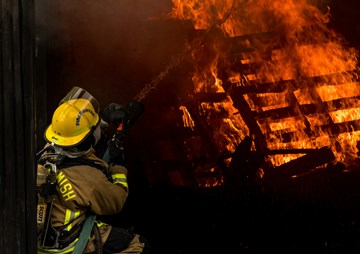
On Saturday evening, three men lost their lives following a fire at a single-storey pavilion on New Zealand Way in White City, west London, close to Queens Park Rangers' Loftus Road stadium. London Fire Brigade received the first of 19 emergency calls at 6.52pm, and mobilised crews from North Kensington, Acton, Chiswick and surrounding stations. Despite the efforts of firefighters, who rescued three men from the building, two were pronounced dead at the scene and a third died later in hospital. Over half of the structure was damaged by the fire, which was brought under control by 9.25pm.
The cause remains under investigation by the Brigade's specialist fire investigation officers and the Metropolitan Police, so it would be wrong to speculate on what went wrong. But as a fire risk assessor with over 26 years in the UK Fire Service, incidents like this are a sobering reminder of how quickly a fire in a relatively small, single-storey building can turn fatal, and why proper fire safety management in non-domestic premises is never something to put off.
Pavilions, Clubhouses and Community Buildings Are Often Overlooked
Sports pavilions, clubhouses and similar community buildings often fall into a grey area when it comes to fire safety. They're not large enough to feel like a "serious" fire risk in the way an office block or hotel might, they're frequently used by volunteers rather than professional facilities staff, and they can go years without anyone formally reviewing how a fire would be detected, contained or escaped from.
That's exactly the kind of building where a fire risk assessment earns its keep. A single-storey structure with limited compartmentation can allow fire to spread through more than half the building before crews even arrive, as happened in White City. The questions a proper assessment forces you to confront are straightforward but easily neglected:
- Are smoke alarms and detection systems fitted, tested, and adequate for the size and use of the building?
- Are escape routes kept clear, well-signed, and wide enough for the number of people who might be inside?
- Is there a means of raising the alarm quickly, and do the people using the building know what to do if it sounds?
- Are electrical installations, heating sources, and any stored materials properly managed and inspected?
- Has the risk to anyone with mobility issues or disabilities been specifically considered?
Fire Risk Assessments Are a Legal Duty, Not an Optional Extra
Under the Regulatory Reform (Fire Safety) Order 2005, anyone responsible for non-domestic premises in England and Wales has a legal duty to carry out a suitable and sufficient fire risk assessment, and to keep it under regular review. This applies whether you run an office, a hotel, a block of flats, a sports club, or a small community pavilion. Following the Grenfell Tower Inquiry, scrutiny of fire safety compliance — particularly around shared and communal buildings — has only increased, and enforcement action against those who fail to meet their obligations has become more rigorous.
A fire risk assessment isn't a box-ticking exercise. Done properly, it identifies the specific hazards present in your building, the people most at risk, and the practical steps needed to reduce that risk to an acceptable level — backed up by an action plan with realistic timescales. It should be revisited whenever the building's use changes, after any significant incident, or at sensible regular intervals regardless.
Don't Wait for an Incident to Find Out What You've Missed
Incidents like White City are rare, but they happen often enough to demonstrate exactly what's at stake when fire safety isn't given the attention it deserves. Whether you manage a sports club, a block of flats, a hotel, or a commercial premises anywhere in the capital, a professional fire risk assessment is the clearest way to understand your current position and close any gaps before they become a real emergency.
At Whale Fire, we carry out London Fire Risk Assessments for landlords, businesses, sports clubs and community organisations across the capital, drawing on direct operational fire service experience rather than a generic checklist approach. If it's been a while since your premises were properly assessed — or you've never had one carried out at all — now is a sensible time to put that right.
Get in touch with Whale Fire today to arrange a fire risk assessment for your premises. Contact Us - Whale Fire
Fire Risk Assessments for London Landlords: What the Law Requires
London's rental market has a particular set of fire risk factors: converted period properties, dense HMOs, ageing tower blocks, and a high proportion of multi-occupied buildings with shared escape routes. If you're a landlord operating in London, fire risk assessment isn't a box-ticking exercise. It's a legal duty, and enforcement by London Fire Brigade has become significantly more active in recent years.
This article sets out what the law actually requires, who's responsible, and what's changed for 2026.
The legal framework
Fire safety duties for landlords sit across several pieces of legislation, and they layer on top of each other rather than replacing one another:
The Regulatory Reform (Fire Safety) Order 2005 is the foundation. It places a duty on the "Responsible Person" to carry out a suitable and sufficient fire risk assessment, identify hazards, and put in place reasonable precautions, with a particular focus on shared spaces such as communal hallways, stairwells, and entrance areas.
The Fire Safety Act 2021 clarified that this duty extends further than many landlords assumed. It confirmed that the structure and external walls of a building (including cladding and balconies) and individual flat entrance doors in multi-occupied residential buildings all fall within scope of the fire risk assessment, not just the obvious communal areas.
The Fire Safety (England) Regulations 2022 introduced specific, measurable obligations: quarterly checks on fire doors in communal areas, annual checks on all fire doors, provision of fire safety information to residents, and a duty to share relevant fire safety information with the local fire and rescue service.
The Building Safety Act 2022 added a further layer for higher-risk buildings, defined as those at least 18 metres tall or with seven or more storeys. These require registration with the Building Safety Regulator, a named Principal Accountable Person, and a "golden thread" of building safety information that must be kept up to date and available on demand.
The Fire Safety (Residential Evacuation Plans) (England) Regulations 2025 came into force on 6 April 2026 and represent the most significant recent change. Qualifying residential buildings now need person-centred risk assessments and evacuation plans, including provisions for residents who would need additional support to evacuate safely. If you manage residential blocks, this is worth checking against your current arrangements without delay.
Who is the "Responsible Person"
Under the 2005 Order, the Responsible Person is whoever has control of the premises, typically the landlord, freeholder, or managing agent acting on their behalf. Where a managing agent is appointed, they can carry out the practical work, but the underlying legal liability stays with the landlord. It cannot be informally handed off. Any transfer of specific fire safety duties to a tenant (in a commercial let, for example) needs to be set out in writing in the lease.
In buildings with multiple occupiers, more than one party can hold Responsible Person duties for different parts of the same building, which is exactly the kind of arrangement that creates gaps if it isn't documented clearly.
What a fire risk assessment actually covers
A "suitable and sufficient" fire risk assessment, in practice, looks at:
- Fire hazards present in the building (electrical installations, kitchens, storage, heating sources)
- Who is at risk, including vulnerable residents who may need extra support to evacuate
- The adequacy of existing precautions: alarms, detection, fire doors, signage, lighting, extinguishers, compartmentation
- Escape routes and whether they remain clear and usable
- A written record of findings, actions required, and a review date
There is no fixed legal interval for review, but the assessment must be revisited whenever something material changes: a change of use, a refurbishment, a new tenant population, or simply when there's reason to believe it no longer reflects the current risk. In practice, an annual review is the sensible minimum for most rented properties, with HMOs and higher-occupancy buildings reviewed more frequently.
HMOs: the additional layer
Houses in Multiple Occupation carry extra obligations under the Housing Act 2004 and local HMO licensing conditions, which sit alongside the Fire Safety Order rather than replacing it. London boroughs vary somewhat in their specific licensing requirements, but common conditions include interlinked smoke and heat alarms, fire doors to a specified standard, and clear, unobstructed escape routes from every room. Given how many London HMOs occupy converted period properties never designed with multi-occupancy in mind, this is consistently where the most serious compliance gaps turn up.
What non-compliance actually costs
Enforcement is not theoretical. London Fire Brigade can issue improvement notices, prohibition notices restricting the use of a building until issues are resolved, and prosecute for breaches. Penalties under the Fire Safety Order are unlimited fines, and in serious cases, imprisonment. Beyond the legal exposure, an inadequate fire risk assessment can also undermine a landlord's position with insurers if a fire does occur.
Where to start
If you don't currently have a written, in-date fire risk assessment for your property, that's the first gap to close. If you have one but it predates the 2022 Regulations, the 2025 evacuation plan changes, or any recent refurbishment, it needs reviewing against the current requirements rather than assumed to still be valid.
Whale Fire carries out fire risk assessments for landlords across London, covering single lets, HMOs, and residential blocks, with clear, actionable reports rather than generic templates. Get in touch through our contact page to arrange an assessment or to have an existing one reviewed against the current legal framework. Contact Us - Whale Fire
The Importance of Fire Safety Signage
The Importance of Fire Safety Signage
Walk around most commercial premises and you'll see fire safety signs so often that they become invisible. Exit signs above doors. A fire action notice by the alarm call point. An extinguisher with a red sign mounted above it. After a while, people stop noticing them — which is exactly when they become critical.
Fire safety signage isn't decoration. It's a legal requirement, and when something goes wrong, it can be the difference between an orderly evacuation and a chaotic one.
What the Law Says
Two main pieces of legislation govern fire safety signage in the UK:
The Regulatory Reform (Fire Safety) Order 2005 (RRO) is the cornerstone of fire safety law in England and Wales. Under Article 14, the responsible person — typically the employer, building owner or occupier — is legally required to ensure that escape routes and exits are clearly marked and that fire safety signage is provided, visible and maintained. Non-compliance can result in enforcement notices, unlimited fines, or in serious cases, prosecution and imprisonment.
The Health and Safety (Safety Signs and Signals) Regulations 1996 sets out the specific design, colour and format requirements that fire safety signs must meet — including when illuminated or photoluminescent signs are required.
For high-rise residential buildings, the Fire Safety (England) Regulations 2022 — introduced following the Grenfell Tower Inquiry — introduced additional requirements, including wayfinding signage to assist fire and rescue services navigating the building.
The Four Main Categories of Fire Safety Signs
1. Fire Action Notices
These tell people what to do if they discover a fire or hear the alarm. They should display the fire brigade number, which exits to use, where the assembly point is, and any other relevant instructions. They must be displayed at fire alarm call points and at final exit doors.
2. Fire Exit and Escape Route Signs
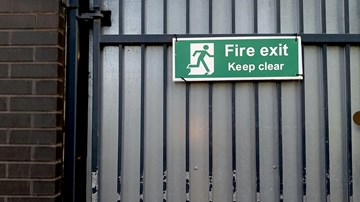
The familiar green running man. These signs direct people to the nearest exit and must mark escape routes clearly, with directional arrows where needed. Premises with straightforward single-exit layouts may have limited requirements, but any building with a complex layout, multiple floors or large occupancy must ensure every exit route is signed throughout.
Fire exit signs must be legible in all conditions. Where a building requires emergency lighting, exit signs will typically also need illumination — either internally lit, externally lit, or photoluminescent.
3. Fire Door Signs
Every fire door must be signed. The standard sign reads "Fire Door — Keep Shut." Doors that are designed to be held open by a magnetic release must carry "Fire Door — Keep Clear" signage. This matters because a fire door propped open or left unlocked defeats its purpose entirely.
4. Fire Equipment Signs
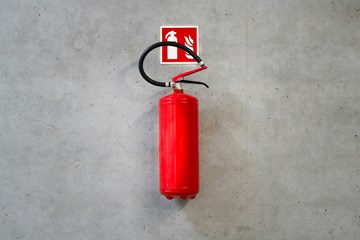
Red signs identify fire extinguishers, hose reels and other firefighting equipment. Every premises with a fire extinguisher must have a corresponding ID sign. Fire alarm call points must also be clearly signed.
Assembly point signs — green, showing a group of people — must be positioned well away from the building and visible to people evacuating.
Why Signage Gets Overlooked — and Why That's a Problem
In busy workplaces, signs get covered by furniture, obscured by stored stock, damaged or simply never replaced when they fade or peel. It's one of the most common issues identified during fire risk assessments.
The problem is that signage failures are invisible during normal operations. Nobody notices the exit sign that's been blocked by a shelving unit until there's smoke in the corridor. At that point, it's too late to fix.
There are a few recurring issues worth being aware of:
Obstructed signs. A sign hidden behind a door, above a high shelf or covered by a notice board is non-compliant and potentially dangerous. Signs must have a clear line of sight from any point along the escape route.
Faded or damaged signs. Signs deteriorate over time, particularly in environments with direct sunlight, humidity or chemical exposure. Photoluminescent signs lose their effectiveness if they haven't been charged by adequate light levels.
Incorrect signs. Using the old British Standard "green running man" design rather than the current ISO 7010 standard, or using signs that don't reflect the actual layout of the building, are both issues that can arise over time — particularly after refurbishments or layout changes.
Missing signs. Any new escape route, fire door or piece of equipment needs appropriate signage. Changes to building layout or use that aren't reflected in the signage create gaps in the fire safety provision.
Signage and the Fire Risk Assessment
Under the RRO, every non-domestic premises must have a current fire risk assessment. Signage is a core element of that assessment. A competent assessor will check that:
- All escape routes are signed throughout their length
- Exit signs are illuminated or photoluminescent where required
- Fire doors are correctly signed
- Equipment is clearly identified
- Assembly points are marked and accessible
- Action notices are in place and up to date
If deficiencies are found, they'll be recorded as action points. Depending on severity, they may be classified as requiring immediate remedial action or as recommendations for improvement. Either way, they need to be addressed.
A Simple Point
Fire safety signage is one of the lowest-cost, highest-impact elements of fire safety provision. A set of compliant signs for a small commercial premises costs relatively little. The consequences of getting it wrong — in terms of legal liability, enforcement action, or harm to the people on your premises — are far greater.
If you haven't reviewed your signage recently, or if you're not certain your current provision meets the requirements for your premises, it's worth getting it checked as part of a professional fire risk assessment.
Whale Fire carries out fire risk assessments across a wide range of commercial, industrial and residential premises. If you'd like to discuss your fire safety requirements, get in touch Contact Us - Whale Fire