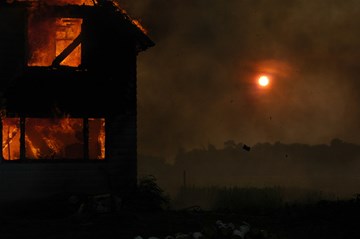
Most people think of a fire as something that happens in one room, or one flat. Put it out, deal with the damage, move on.
But anyone who has served in the fire service knows that's not how it works in many of London's buildings. Fire and smoke will find every gap, every void and every weak point. If the building isn't built and maintained to hold a fire back, it can travel from one flat to another, through a shared roof space into the house next door, or up a hidden cavity to floors above, often far faster than people expect.
That's why compartmentation matters so much, and why London, with its unique mix of old and new buildings, needs fire risk assessments that look properly at how fire could spread.
What is compartmentation?
Compartmentation is the principle of dividing a building into separate fire-resisting sections, or "compartments". Each flat, each stairway and each corridor is designed to hold back fire and smoke for a set time, typically 30 or 60 minutes.
That time is what keeps people alive. It allows residents to escape, or in many blocks of flats to stay safely in their own flat while the fire is dealt with. It also gives firefighters the time and the safe access they need.
Compartmentation relies on several things working together:
- Fire-resisting walls and floors between flats and common areas
- Fire doors that close fully on their own, with intact seals and the right hardware
- Fire stopping that seals the gaps where pipes, cables and ducts pass through walls and floors
- Cavity barriers that close off hidden voids in walls, ceilings and roof spaces
If just one of those is missing or damaged, the whole system can fail.
How fire spreads from property to property
In practice, fire usually spreads between properties through routes no one can see:
- Shared or open roof voids. In many terraces and blocks, loft spaces run across several homes with little or no fire separation. Once fire gets into the roof, it can travel along it quickly.
- Penetrations through walls and floors. Every new cable, pipe or extractor duct is a potential hole in the compartment if it isn't properly fire stopped.
- Poor-quality conversions. Houses split into flats where the floors between them were never upgraded, or where the original fire separation was cut through during building work.
- Missing or damaged fire doors. A flat entrance door that doesn't close, has been replaced with a standard door, or has had its seals painted over.
- External routes. Fire breaking out of windows and spreading up or across the outside of the building, through combustible materials, eaves or balconies.
Why London is especially at risk
London's buildings present a challenge you won't find to the same extent anywhere else in the UK.
Victorian and Edwardian terraces make up huge parts of the city. Many have been converted into flats, often decades ago, and often by different owners at different times. The fire separation between flats may never have been up to standard in the first place, and years of alterations, rewiring and refits can leave it riddled with gaps.
Houses in multiple occupation (HMOs) are common, with several unrelated people living under one roof and sharing escape routes.
Shops with flats above line almost every high street. A fire in a takeaway kitchen or a storage area can put the residents upstairs at serious risk if the separation between the commercial and residential parts isn't adequate.
Purpose-built blocks, from post-war estates to modern developments, depend entirely on compartmentation to make their fire strategy work.
And because buildings in London sit so close together, a fire in one property puts its neighbours at risk too.
Recent London Fire Brigade incidents show the pattern clearly. In May 2026, a fire at a converted mid-terraced house in Thornton Heath spread through the ground and first floors and the whole roof, and also reached part of a neighbouring property. The same month, in Bellingham, a fire destroyed the roof of an end-of-terrace house and partly damaged the loft of the house next door.
The lessons go back much further. The Lakanal House fire in Camberwell in 2009 killed six people, and investigators found breaches in fire-resisting construction, a lack of compartmentation in suspended ceilings and fire doors without smoke seals. More recently, an independent review of a major fire at Fox House in Battersea found that fire had spread across the block's roof space in around ten minutes, and called on the council to inspect roof and communal voids across its housing.
The Grenfell Tower tragedy in 2017 changed the way the whole country thinks about fire safety in residential buildings, and the work to put the Inquiry's recommendations into practice is still going on.
What the law says
If you are responsible for a building in London, whether you're a landlord, managing agent, freeholder, business owner or residents' management company, you have legal duties.
Under the Regulatory Reform (Fire Safety) Order 2005, the "Responsible Person" must carry out a suitable and sufficient fire risk assessment, and keep the fire safety measures in place and working. Compartmentation and fire stopping are part of those measures.
The Fire Safety Act 2021 made it clear that, in buildings containing two or more homes, the Fire Safety Order covers the structure, external walls (including balconies and windows) and the entrance doors to individual flats.
Since October 2023, further changes mean that all Responsible Persons must record their full fire risk assessment in writing, along with their fire safety arrangements, regardless of the size of the business or building. There are also extra duties for buildings with flats, including fire door checks and sharing fire safety information with residents.
In short, "we've never had a problem" is not a defence.
What a good fire risk assessment should look at
A fire risk assessment is far more than a tick-box exercise. For compartmentation and fire spread, a competent assessor should be looking at:
- Fire doors: flat entrance doors and communal doors, including self-closers, seals, gaps and signage
- Visible fire stopping: around services in risers, cupboards, meter areas and ceiling voids where access allows
- Roof spaces and voids: where they can be safely accessed, checking for separation between properties
- Conversions and alterations: whether past building work has compromised the original fire separation
- Mixed-use risk: the separation between commercial premises and the homes above
- Escape routes: whether they're kept clear and protected from fire and smoke
- Detection and warning: whether the alarm system suits the building and how people would be alerted
- Contractor control: how the building makes sure that new work, like cabling, plumbing or broadband installations, doesn't create new holes
Where the assessor can't see inside the building's structure but has good reason to suspect problems, they should say so clearly and recommend further investigation, such as an intrusive survey by a specialist.
Practical steps for London landlords and building owners
- Make sure you have an up-to-date written fire risk assessment carried out by a competent, accredited assessor.
- Review it regularly, and always after any significant building work, change of use or incident.
- Check your fire doors. If a door doesn't close fully on its own, it isn't doing its job.
- Control your contractors. Anyone drilling through walls or ceilings must make good the fire stopping, and you should check that they have.
- Don't ignore the roof space. If you don't know whether your loft is separated from the neighbours', find out.
- Keep records of inspections, repairs and maintenance. If something ever goes wrong, you'll need to show what you did.
- Act on the findings. An assessment that sits in a drawer protects no one.
How Whale Fire can help
At Whale Fire, we bring about 20 years' experience of assessing buildings, alongside a career in the UK Fire Service. We've seen first-hand what happens when compartmentation fails, and we know what to look for.
We're accredited with NSI, Associate Members of the Institute of Fire Safety Managers (AIFSM), and listed on the National Fire Risk Assessor Register (NFRAR). Our approach is common-sense, practical and client-friendly. We tell you clearly what needs doing, why it matters, and how urgent it is, without the jargon.
Whether you own a single converted house, manage a block of flats, or run a shop with homes above it, we can help you understand your fire risks and meet your legal duties.
Contact Whale Fire today to arrange a fire risk assessment for your London property.
Whale Fire – Extinguish the Risk.