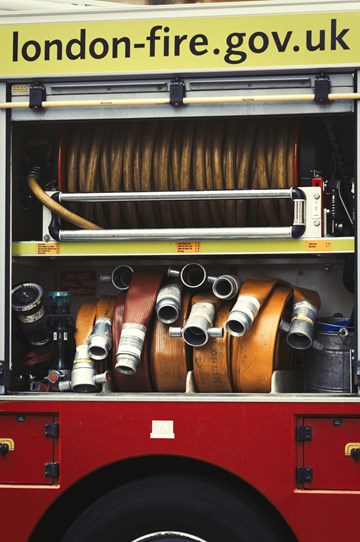
On Thursday morning, 5 November, a fire broke out in a warehouse on Bolina Road in Rotherhithe, south London. It was first reported at around 8am. The London Fire Brigade sent eight fire engines and around 60 firefighters.
The fire was on a first-floor mezzanine in a mid-terraced industrial unit, and part of that mezzanine was destroyed. Thick black smoke could be seen across the London skyline, and local residents were told to keep their windows and doors closed. Crews used a 32-metre turntable ladder as an observation tower, and the Brigade's drone team gave officers a view from the air. Firefighters came from Old Kent Road, New Cross, Deptford, Dockhead, Bethnal Green, East Greenwich, Greenwich and Dowgate fire stations.
The Met Police and the LFB's Fire Investigation team are looking into the cause. I won't guess what started this fire. But I have attended many warehouse fires over 27 years, and they tend to follow the same patterns. Every warehouse owner and manager should understand them.
Why warehouse fires are so dangerous
Warehouse fires grow fast and are hard to put out. From the firefighting side, there are four main reasons.
1. A lot of fuel in one place. Pallets, cardboard, plastic wrapping, foam and stock are stacked high and close together. Once a fire takes hold, it has plenty to feed on.
2. Large open spaces. Big floor areas with few internal walls let fire and smoke spread quickly. There is little to hold the fire back while people escape and crews arrive.
3. Mezzanines. Mezzanine floors, like the one involved in Rotherhithe, are a particular concern. They are often added years after the building was designed, sometimes without proper fire protection underneath or a second way down. Smoke rises and gathers at that level first, so anyone working up there can be cut off quickly.
4. Smoke and toxic gases. Burning plastics and packaging give off thick, toxic smoke. That's the black plume Londoners saw on Thursday. Smoke, not flames, is what usually kills people in a fire.
These buildings are also often in terraces next to other businesses or homes. A fire in one unit can quickly become everyone's problem.
What usually starts warehouse fires
The cause in Rotherhithe is still under investigation. In general, though, most warehouse fires I've seen come down to a short list of causes:
- Electrical faults: overloaded sockets, damaged cables, old wiring and poorly maintained equipment.
- Lithium-ion batteries: e-bikes, e-scooters, power tools and stock being stored or charged on site, often overnight and unattended.
- Hot work: welding, cutting or grinding near combustible materials, with no permit or fire watch.
- Forklift and plant charging: charging areas set up too close to stock.
- Careless smoking: cigarettes not put out properly near loading bays and bins.
- Arson: waste and pallets stacked against the outside of a building make an easy target.
- Poor housekeeping: rubbish, packaging and waste left to build up, blocking exits and giving a small fire somewhere to go.
Nearly all of these can be prevented. That's what a good fire risk assessment is for.
What the law says
In England and Wales, warehouses and other commercial premises are covered by the Regulatory Reform (Fire Safety) Order 2005. Scotland and Northern Ireland have their own equivalent laws.
The law puts the duty on the "Responsible Person". That's usually the employer, the owner or whoever controls the premises. They must:
- Carry out a suitable and sufficient fire risk assessment, and keep it under review.
- Record the significant findings in writing if there are five or more employees (and in practice it's wise to do this anyway).
- Put suitable fire safety measures in place, such as detection and alarms, firefighting equipment, emergency lighting and signage.
- Keep escape routes and fire exits clear and usable at all times.
- Give staff proper fire safety training and information.
- Maintain fire safety equipment and systems.
A fire risk assessment is not a one-off box-ticking exercise. It should be reviewed regularly, and again whenever something changes: a new mezzanine, a change in stock, new tenants, a new process or more staff.
If you don't comply, you can be prosecuted, and fines are unlimited. Your insurance could also be affected. Most importantly, people could be hurt.
A practical checklist for warehouse owners and managers
You don't have to do everything at once. Start at the top of this list and work down.
- Check your fire risk assessment. Is it up to date? Was it done by someone competent? Does it reflect how the building is used today?
- Look at your mezzanines. Is there fire protection underneath? Is there a safe way down, and does the alarm cover that level?
- Test your fire alarm weekly and keep a log. Make sure it can be heard everywhere, including in noisy areas.
- Walk your escape routes. Are exits clear, unlocked when people are inside, and signed? Is the emergency lighting working?
- Control battery charging. Charge e-bikes, scooters and power tools in a set area away from stock, and never leave them charging unattended overnight.
- Manage hot work. Use a hot work permit, clear combustibles away, and keep a fire watch going after the job is finished.
- Keep waste away from the building. Store bins and pallets well away from walls, and empty them regularly.
- Watch your stacking. Keep clear space below sprinkler heads and lights, and don't let aisles shrink.
- Train your staff. Everyone should know how to raise the alarm, where to go and who is in charge. Run a fire drill at least once a year.
- Service your equipment. Extinguishers, alarms, emergency lighting and sprinklers all need regular professional maintenance.
If you share a terrace or a building with other businesses, talk to them. Fire doesn't respect boundary lines, and your plans need to work together.
Don't wait for your own headline
Incidents like Rotherhithe remind us that a fire can start at any time, often early in the morning before anyone has noticed. Even when everyone gets out safely, the damage to stock, to the building and to the business can take months or years to recover from. Some businesses never do.
At Whale Fire, we carry out common-sense, practical fire risk assessments for warehouses, industrial units, offices, shops and other commercial premises across London and the UK. You get plain-English advice and clear priorities, from someone who has spent 27 years dealing with what happens when fire safety goes wrong.
Book your fire risk assessment today.
Call free on 0800 772 0738 or email info@whalefire.co.uk for a no-obligation quote.
Whale Fire – Extinguish the Risk.
Sources
- AOL / The Standard: "Dozens of firefighters battle warehouse blaze in south London" (5 November 2026) – https://www.aol.co.uk/articles/dozens-firefighters-battle-warehouse-blaze-131847000.html
- Need to Know: "Fire rips through London warehouse as crews rush in" (5 November 2026) – https://needtoknow.co.uk/2026/11/05/fire-rips-through-london-warehouse/
- GOV.UK: Regulatory Reform (Fire Safety) Order 2005 – https://www.legislation.gov.uk/uksi/2005/1541/contents