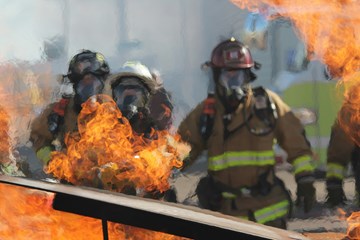
A major wildfire that tore through heathland at Dunwich, on the Suffolk coast, has now burned for several days, destroying an area equivalent to around 210 football pitches. The blaze, which started at RSPB Minsmere on a Wednesday evening and spread onto the National Trust's Dunwich Heath, has been described by the charity as leaving the landscape "unrecognisable" — and its effects will be felt for years to come.
While the fire is now stable, thanks to extensive firebreaks dug by Suffolk Fire and Rescue Service, it's a striking reminder that wildfire is no longer a risk confined to the height of a heatwave or to remote countryside. It's a live operational challenge that fire and rescue services, landowners, and businesses across the UK increasingly need to plan for.
What Happened
The fire began at RSPB Minsmere and spread rapidly across dry heathland toward Dunwich Heath, ultimately affecting around 150 hectares. Suffolk Fire and Rescue Service treated it as a major incident, deploying up to ten fire appliances at the peak of daytime operations and creating firebreaks up to 12 metres wide around the entire site to stop flames and embers spreading further. Nearby Leiston Abbey was evacuated as a precaution, with a local boarding school stepping in to house displaced groups.
The site sits only a few miles from the Sizewell B nuclear power plant, underlining how wildfire risk can intersect with critical national infrastructure even when the fire itself poses no direct threat to a facility.
Why This Matters Beyond Suffolk
For anyone responsible for fire risk assessment, this incident is a useful case study in several respects:
- Wildfire is now a mainstream UK risk, not an exceptional one. Prolonged dry spells and changing weather patterns are making heathland, moorland, and forested sites more vulnerable across the country, not just in traditionally fire-prone regions.
- Major incidents strain fire and rescue capacity. When a service commits significant resources to a large-scale wildfire over several days, its capacity to respond quickly elsewhere is reduced. This is a factor worth building into risk assessments for premises in rural or semi-rural areas, particularly those some distance from a fire station.
- Sites near sensitive infrastructure carry extra weight. The proximity of this fire to a nuclear power station is a reminder that fire risk assessments for infrastructure, industrial, and commercial sites near natural land should factor in external wildfire exposure, not just risks originating within the building or site boundary.
- Firebreaks and land management are genuine mitigation tools. The creation of wide firebreaks was credited with stabilising this fire. Landowners and site managers with adjoining heath, grass, or woodland should consider whether vegetation management, cleared perimeters, or coordination with the local fire service form part of their existing fire safety planning.
- Recovery timelines are long. The charities involved have been clear that ecological and landscape recovery will take years. The same is often true of commercial or heritage sites damaged by fire — a point worth factoring into business continuity planning, not just prevention.
The Fire Risk Assessment Angle
Most fire risk assessments understandably focus on risks that originate inside a building — electrical faults, storage of combustibles, escape routes, and so on. Incidents like this highlight the value of also considering external and environmental fire risk, especially for:
- Rural or semi-rural commercial premises
- Sites adjoining heathland, grassland, moorland, or woodland
- Infrastructure or industrial sites in areas with limited fire service coverage
- Heritage or environmentally sensitive locations where recovery from fire damage is slow and costly
A thorough fire risk assessment should account not only for how a fire might start inside a premises, but how a fire starting nearby — including a wildfire — could affect access, evacuation, and the availability of emergency response.
If your business or site sits near open land, now is a sensible time to review whether external fire risk has been properly considered as part of your fire safety planning. Contact Us - Whale Fire