A large fire at James Allen Joinery on Lodge Road in Hollesley, Suffolk, has once again shown how quickly a workshop fire can escalate — and how much it can demand of the fire service, local businesses, and the surrounding community. As a Watch Commander with over 26 years in the Fire Service, incidents like this are exactly the kind of case study worth breaking down for anyone responsible for fire safety in a commercial premises.
What Happened
Suffolk Fire and Rescue Service was called to the scene shortly before 9am on Thursday 9 July, after multiple reports of a blaze at the joinery business. A dozen fire crews attended from stations across the county — Ipswich East, Ipswich Princes Street, Saxmundham, Felixstowe, Framlingham, Beccles, Needham Market, Haverhill, Newmarket, Stowmarket, Bury St Edmunds and Long Melford — alongside specialist appliances including an aerial ladder, rescue tender, water carrier and command support vehicle.
By the time crews arrived, the building — roughly 30 metres by 15 metres — was already around 90% involved in fire. The premises contained gas cylinders and had an asbestos roof, both significant complicating factors for any incident commander. Firefighters used three hose jets, two larger hose lines, and a hydrant, supported by a water relay system, and deployed an aerial ladder as a water tower to reach the fire in the middle of the workshop. The fire was reported under control by around 11:10am, though crews remained on scene for several hours afterwards, with relief units arriving to support the original teams. No casualties were reported, and The Salvation Army was requested to provide welfare support for firefighting crews — a detail that says a lot about the scale and duration of the operation.
Notably, the incident also drew in the local farming community: nearby farmer Thomas Buckle supplied fire crews with water via an irrigation pump, with an estimated 10,000 litres used to help control the flames, after station manager Alex Smith highlighted that water resources in the area were limited.
Why This Incident Matters for Fire Risk Assessments
Every large-scale commercial fire offers lessons for other businesses, and this one raises several points worth flagging for any premises with a similar risk profile.
1. Joinery and woodworking premises are high fuel-load environments
Timber, sawdust, finishes, and stored materials all add up to a significant fuel load. Once ignition takes hold in a workshop like this, fire can spread rapidly through stock, machinery, and structural timber before crews arrive — which is consistent with how quickly this building reportedly became fully involved.
2. Stored cylinders change the entire risk calculation
The presence of gas cylinders inside the building is a critical detail. Compressed or flammable gas cylinders can fail catastrophically when exposed to fire, and their presence directly shapes how incident commanders approach tactics, exclusion zones, and crew safety. If your business stores cylinders on site — for welding, heating, or process use — your fire risk assessment needs to address safe storage location, separation distances, signage, and what the fire service needs to know if called to your premises.
3. Asbestos roofing adds a layer of complexity
An asbestos roof significantly affects both firefighting tactics and the post-incident environment. Fire damage to asbestos materials can release fibres, creating an additional hazard for firefighters, investigators, and anyone returning to the site afterwards. If your building has legacy asbestos materials, your fire risk assessment and your asbestos management plan need to talk to each other — not sit in separate drawers.
4. Water supply is not guaranteed in rural locations
The reliance on farm irrigation equipment to supplement hydrant supply is a striking reminder that firefighting water availability varies significantly by location. Rural and semi-rural commercial premises should never assume mains water pressure and hydrant coverage will be sufficient — this is something a competent fire risk assessment should specifically consider, including whether additional water supply arrangements (static tanks, agreements with neighbouring landowners, etc.) are appropriate.
5. Dry weather conditions increase external fire spread risk
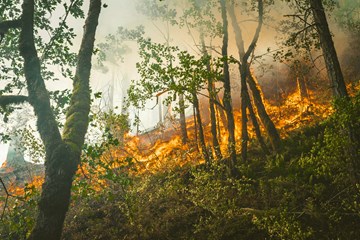
Reports from the scene noted that dry conditions contributed to the fire spreading to nearby vegetation. As UK summers trend hotter and drier, businesses with adjacent hedgerows, grassland, or vegetation need to factor wildfire-style spread into their site risk picture, not just internal fire spread.
The Takeaway for Business Owners
Incidents like Hollesley don't happen because someone was careless — they happen because risk factors stack up: combustible materials, stored gases, legacy building materials, and site-specific challenges like water supply. A proper fire risk assessment doesn't just tick a compliance box; it identifies exactly these kinds of compounding risks before they combine into a 12-crew, day-long incident.
If your business handles timber, stores cylinders, occupies an older building with legacy materials like asbestos, or sits somewhere firefighting water supply might be a challenge, now is a good time to review your fire risk assessment — not after an incident like this one.
Whale Fire Ltd helps businesses across the UK identify and manage exactly these risks. Get in touch if you'd like a professional fire risk assessment for your premises. Extinguish the Risk. Contact Us - Whale Fire
Sources: East Anglian Daily Times, "Farmers praised for support in tackling Hollesley fire" and "Hollesley farmer assists firefighters during day long blaze," 10 July 2026; BBC News, "Twelve fire crews tackle large joinery blaze in Hollesley," 10 July 2026.