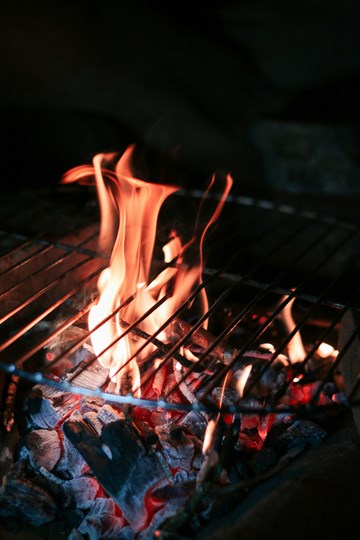
On the evening of 21 June 2026, a fire broke out along a row of terraced houses near Rookyards in Basildon, Essex. Within hours, eight homes had been declared uninhabitable. Essex County Fire and Rescue Service sent crews from seven stations, including an aerial ladder platform, and the blaze burned on into the night before being brought under control.
The cause, confirmed by investigators as accidental, was a disposable barbecue. A resident had cooked food on a single-use grill and gone back inside. Within minutes, nearby vegetation had caught light, and the fire spread rapidly to the roofline. Because the properties were a connected terrace with no fire breaks between the roof voids, the fire moved freely from one home to the next, eventually taking out the entire row.
Every family on that terrace lost their home in less time than it takes to eat a meal.
Why disposable BBQs are a heightened risk in hot weather
Disposable barbecues are designed to be cheap and convenient, not to be safe in extreme heat. During a heatwave, several factors combine to raise the risk significantly:
- They stay hot for much longer than people expect. In normal conditions a disposable BBQ can retain dangerous heat for several hours after use. In high ambient temperatures, that cooling time extends further, and a grill that looks "out" can still ignite dry grass, decking, or fencing.
- Surrounding vegetation and ground are tinder-dry. Sustained hot weather dries out grass, hedging, and timber garden structures, turning a single ember or radiant heat source into a fast-moving fire.
- A slight breeze is enough. Wind doesn't need to be strong to carry embers or fan a smouldering patch of grass into open flame.
- People underestimate the distance fire needs to spread. A BBQ placed near a fence line, shed, or decking gives fire a direct route to the building fabric — and from there, into roof spaces.
The compartmentation problem in terraced and semi-detached property
The detail that turned this into an eight-home incident, rather than a single garden fire, is structural: many older terraces and semis were built with continuous roof voids and no fire-resisting breaks between adjoining properties. Once fire gets into that roof space, it can travel along the entire row largely unseen, often well before residents are aware anything is wrong.
This is a known and recurring issue in UK housing stock, and it has direct relevance for anyone managing rented residential property:
- If you hold properties in a terrace or semi-detached block, you should know whether fire-resisting separation exists between roof voids, and whether party wall fire-stopping is intact and undamaged by previous works (loft conversions, rewiring, or cabling runs are common culprits for breached compartmentation).
- Where you manage blocks or HMOs with shared means of escape, your duties under the Regulatory Reform (Fire Safety) Order 2005 and the Fire Safety Act 2021 extend specifically to structure, external walls, and compartmentation, not just the more visible items like alarms and extinguishers.
- The Building Safety Act 2022 and the residential evacuation planning changes that followed in 2025 have sharpened expectations around evacuation strategy documentation. A fire that can travel between units faster than residents can react makes this planning far more than a paperwork exercise.
What landlords and property managers should be doing now
With the current heatwave likely to continue, there are practical steps worth taking immediately, alongside the longer-term structural checks above:
- Communicate with tenants. A short, clear reminder about disposable BBQ risk — keeping them away from fences, decking, sheds, and dry vegetation, and fully extinguishing with water rather than just letting them "burn out" — costs nothing and can prevent a serious incident.
- Review garden and outdoor space conditions at your properties. Overgrown, dry vegetation close to the building fabric should be flagged and managed, particularly in shared gardens or communal areas you're responsible for maintaining.
- Check roof void separation where you have terraced or semi-detached stock. If you don't know the condition of the fire-stopping between your property and its neighbours, that's a gap worth closing.
- Revisit your fire risk assessment. If it predates recent works to the property, or hasn't accounted for seasonal risk factors like prolonged hot weather, it needs updating. A fire risk assessment isn't a one-off document — it should reflect the property as it actually is today.
The Basildon fire started with a £6 barbecue and ended with eight families displaced from their homes. The cost of checking compartmentation, reviewing a fire risk assessment, or sending tenants a one-line reminder is negligible by comparison.
If you manage residential property, particularly terraced, semi-detached, or HMO stock, and you're not confident about the condition of fire separation or the currency of your fire risk assessment, Whale Fire can carry out a full assessment and tell you exactly where you stand.