London's rental market has a particular set of fire risk factors: converted period properties, dense HMOs, ageing tower blocks, and a high proportion of multi-occupied buildings with shared escape routes. If you're a landlord operating in London, fire risk assessment isn't a box-ticking exercise. It's a legal duty, and enforcement by London Fire Brigade has become significantly more active in recent years.
This article sets out what the law actually requires, who's responsible, and what's changed for 2026.
The legal framework
Fire safety duties for landlords sit across several pieces of legislation, and they layer on top of each other rather than replacing one another:
The Regulatory Reform (Fire Safety) Order 2005 is the foundation. It places a duty on the "Responsible Person" to carry out a suitable and sufficient fire risk assessment, identify hazards, and put in place reasonable precautions, with a particular focus on shared spaces such as communal hallways, stairwells, and entrance areas.
The Fire Safety Act 2021 clarified that this duty extends further than many landlords assumed. It confirmed that the structure and external walls of a building (including cladding and balconies) and individual flat entrance doors in multi-occupied residential buildings all fall within scope of the fire risk assessment, not just the obvious communal areas.
The Fire Safety (England) Regulations 2022 introduced specific, measurable obligations: quarterly checks on fire doors in communal areas, annual checks on all fire doors, provision of fire safety information to residents, and a duty to share relevant fire safety information with the local fire and rescue service.
The Building Safety Act 2022 added a further layer for higher-risk buildings, defined as those at least 18 metres tall or with seven or more storeys. These require registration with the Building Safety Regulator, a named Principal Accountable Person, and a "golden thread" of building safety information that must be kept up to date and available on demand.
The Fire Safety (Residential Evacuation Plans) (England) Regulations 2025 came into force on 6 April 2026 and represent the most significant recent change. Qualifying residential buildings now need person-centred risk assessments and evacuation plans, including provisions for residents who would need additional support to evacuate safely. If you manage residential blocks, this is worth checking against your current arrangements without delay.
Who is the "Responsible Person"
Under the 2005 Order, the Responsible Person is whoever has control of the premises, typically the landlord, freeholder, or managing agent acting on their behalf. Where a managing agent is appointed, they can carry out the practical work, but the underlying legal liability stays with the landlord. It cannot be informally handed off. Any transfer of specific fire safety duties to a tenant (in a commercial let, for example) needs to be set out in writing in the lease.
In buildings with multiple occupiers, more than one party can hold Responsible Person duties for different parts of the same building, which is exactly the kind of arrangement that creates gaps if it isn't documented clearly.
What a fire risk assessment actually covers
A "suitable and sufficient" fire risk assessment, in practice, looks at:
- Fire hazards present in the building (electrical installations, kitchens, storage, heating sources)
- Who is at risk, including vulnerable residents who may need extra support to evacuate
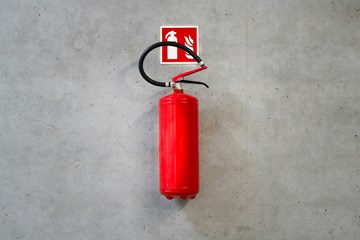
- The adequacy of existing precautions: alarms, detection, fire doors, signage, lighting, extinguishers, compartmentation
- Escape routes and whether they remain clear and usable
- A written record of findings, actions required, and a review date
There is no fixed legal interval for review, but the assessment must be revisited whenever something material changes: a change of use, a refurbishment, a new tenant population, or simply when there's reason to believe it no longer reflects the current risk. In practice, an annual review is the sensible minimum for most rented properties, with HMOs and higher-occupancy buildings reviewed more frequently.
HMOs: the additional layer
Houses in Multiple Occupation carry extra obligations under the Housing Act 2004 and local HMO licensing conditions, which sit alongside the Fire Safety Order rather than replacing it. London boroughs vary somewhat in their specific licensing requirements, but common conditions include interlinked smoke and heat alarms, fire doors to a specified standard, and clear, unobstructed escape routes from every room. Given how many London HMOs occupy converted period properties never designed with multi-occupancy in mind, this is consistently where the most serious compliance gaps turn up.
What non-compliance actually costs
Enforcement is not theoretical. London Fire Brigade can issue improvement notices, prohibition notices restricting the use of a building until issues are resolved, and prosecute for breaches. Penalties under the Fire Safety Order are unlimited fines, and in serious cases, imprisonment. Beyond the legal exposure, an inadequate fire risk assessment can also undermine a landlord's position with insurers if a fire does occur.
Where to start
If you don't currently have a written, in-date fire risk assessment for your property, that's the first gap to close. If you have one but it predates the 2022 Regulations, the 2025 evacuation plan changes, or any recent refurbishment, it needs reviewing against the current requirements rather than assumed to still be valid.
Whale Fire carries out fire risk assessments for landlords across London, covering single lets, HMOs, and residential blocks, with clear, actionable reports rather than generic templates. Get in touch through our contact page to arrange an assessment or to have an existing one reviewed against the current legal framework. Contact Us - Whale Fire